

As discussed in another post, there has been so much vaping law reform in Australia over the past couple of years that it’s easy to overlook significant tobacco control law reforms.
Since 2023, Australia has had a flagship, national tobacco control Act. The Public Health (Tobacco and Other Products) Act 2023 [PHTOP Act] consolidated previous legislation and introduced a number of new controls. This Act operates in conjunction with State and Territory tobacco control legislation: see s 7.
This post provides a very brief overview of the Act. A separate post points to several interesting tobacco controls introduced by New Zealand over the same period.
Tobacco advertising bans
Previously, the Tobacco Advertising Prohibition Act 1992 (Cth) regulated tobacco advertising at the federal level. This Act has now been repealed. Bans on advertising and sponsorship of tobacco and e-cigarettes are now included in Chapter 2 of the PHTOP Act.
The prohibition on the publication of tobacco advertisements in the PHTOP Act now applies to the internet and to telecommunications (see ss 19-20, 30).
Part 2.4 of the Act also includes a ban on the publication of e-cigarette advertisements, which was absent in the previous legislation (see ss 42-43, 56).
Graphic health warnings
Graphic health warnings on tobacco packs have existed for many years in Australia, and since 2012 they have been required to cover 75% of the surface area of the front of the pack, and 90% of the back. The image below shows graphic health warnings coupled with tobacco plain packaging, which standardises the appearance of tobacco packs, eliminates trademarks and other distinguishing features.
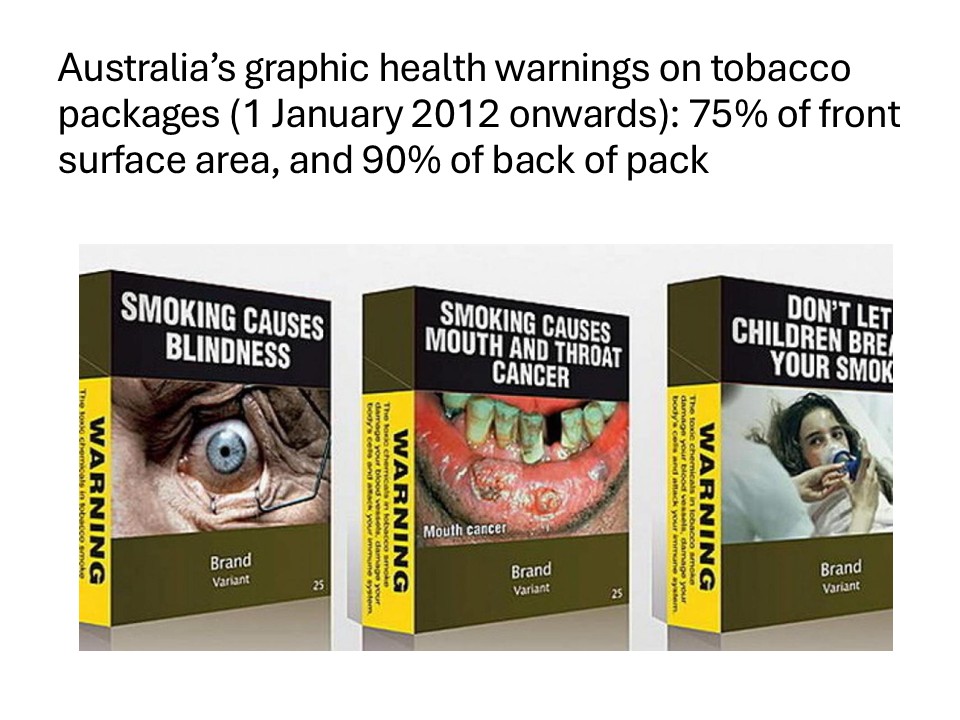
Previously, graphic health warnings were imposed by the Competition and Consumer (Tobacco) Information Standard 2011. However, s 78 of the PHTOP Act stated that the specifications for graphic health warnings on tobacco packages would be set out in the Regulations.
The Public Health (Tobacco and Other Products) Regulations 2024 (as amended) set out detailed requirements for the appearance of cigarette packets and other tobacco packaging.
The size of the health warnings on the front and back of the pack remains the same: see regs 73, 77.
Examples of approved health warnings for cigarettes are included in Schedule 2 of the Regulations.
Since health warnings lose their impact over time, the warnings have been refreshed: they include “dissuasive language”, such as “What would it be like to get THROAT CANCER?” (Health warning 2.1.2), “How does smoking cause erectile dysfunction?” (Health warning 2.3.6), and “Second-hand smoke reduces your child’s lung capacity” (Health warning 2.3.8).
These front-of-pack health warnings operate in conjunction with back-of-pack warnings, which carry on the theme and provide further information.
Health promotion inserts
The PHTOP Regulations provide that health promotion inserts must be included in the packaging of cigarette packs and other tobacco products: see reg 107 and generally Part 3.11.
Health promotion inserts must be inserted at the front of a flip-flop cigarette pack so that they appear in front of the cigarettes when the pack is opened (reg 111).
Examples of approved health promotion inserts are included in Schedule 8 of the Regulations. Unlike many graphic health warnings, which function as “disease warnings”, health promotion inserts provide information and encouragement about quitting smoking.
On-product health messages
Amendments to the PHTOP Regulations also require “on product” health messages to appear on the filter of the cigarette: see regs 114A-114C.
Australia has followed Canada’s example of requiring warnings on individual cigarettes: approved on-product health messages are included in Schedule 10 of the Regulations.
For further information about refreshed graphic health warnings, health promotion inserts and on-product health messages, see here.

New generation tobacco plain packaging requirements
The PHTOP Act continues the process, begun in the Tobacco Plain Packaging Act, of mandating tobacco product requirements.
The Tobacco Plain packaging Act 2011 (Cth) has been repealed, and specifications for the appearance of tobacco packs have been expanded in Chapter 3 of the PHTOP Act.
The new Act expands the statutory “tobacco product requirements” that specify how a tobacco product and package must look, and what features and gimmicks are prohibited.
Some of the gaps that previously existed have been closed.
The tobacco product requirements in the PHTOP Act now extend beyond the colour and finish of the tobacco pack, although the previously mandated colour for tobacco packaging, Pantone 448C (a drab brown) remains a requirement under the new Act: see s 75.
Onserts and inserts are banned except when required under the legislation (such as health promotion inserts, mentioned above): s 82.
Tobacco packs must not produce noise or smell, heat-activeated links are banned, embellishments that show up in blue light are banned; removable tabs and fold out panels that might help to differentiate the product or define brand characteristics are all banned: ss 83-84.
The 2023 Act also prohibits the use of certain words when applied to brands, including terms that imply positive health effects, reduced harm, positive qualities and colours: s 73.
Words cannot be used to draw attention to a quality of the filter: s 73.
Low-tar, light, mild and similar descriptors are also specifically banned (and have been absent from Australian tobacco products for many years since they are misleading and deceptive and infringe consumer protection laws).
But alternative terms, including words that denote colours (which serve as substitutes for prohibited descriptors), are also banned because they enhance brand awareness and communicate false beliefs about the relative harm of different tobacco products.
Terms such as “organic, natural, additive free” are also prohibited: s 73.
The use of non-alphabetical characters, including emojis, emoticons [eg 🙂 ] and also numerals, are prohibited: s 73. This is intended to eliminate the capacity to communicate brand values, differentiate variants (eg 10%), or to draw a link between the brand and a social media account (#Cool): see here pp 10-11.
Flavours and additives
The Regulations set out both permitted (s 122) and prohibited (s 121) ingredients in tobacco products: see also s 87 of the Act.
Under reg 121, additives that add or enhance flavour are banned unless specified in the list given in s 122 of the Regulations. Caffeine, colouring agents, cloves, spices or herbs, sugars and sweeteners, taurine, vitamins and, significantly, menthol, are all listed as prohibited ingredients.
The Act also prohibits novel design features, such as filters with flavoured tips and flavour capsules embedded in filters: s 91.
To sum up, the PHTOP Act and Regulations impose a wide range of second generation bans that are intended to eliminate innovation in tobacco manufacturing and packaging, since any latitude here will be manipulated by tobacco companies to differentiate and promote their lethal products.

Product bans
Hitherto, the importation of certain tobacco products into Australia has been prohibited under the Customs (Prohibited Imports) Regulations 1956 (Cth). These Regulations ban importation of “chewing tobacco or snuffs intended for oral use” unless the quantity is 1.5kg or less: see reg 4(2) and Schedule 3, item 12.
The PHTOP Act now imposes a permanent ban on these products (s 126) and creates offences for possessing or dealing in them (ss 127-128), although exceptions apply where the importation is by an individual for personal use, in amounts that are permitted [under the Customs Regulations].
Tobacco reporting requirements
The PHTOP Act imposes heightened reporting requirements by tobacco companies.
Tobacco companies are now required to disclose tobacco product ingredients (something they only did once previously on a voluntary basis) (s 131), as well as the volumes of tobacco products sold (s 132), as well as their marketing and promotional expenditures (s 133).
This is important because the largest proportion of the advertising budget of tobacco companies in Australia comprises payments to tobacco retailers to encourage retailers to position their brands (in terms of their availability, and price) at point of sale.
As the CEO of one Australian tobacco company once told me, explaining how his company expended its advertising budget:
“[We] work with people like Coles, Woolworths, independents, trying to make sure that we’ve got the right selection of product for the right consumers in the area. And then pricing is the other tool that we’re allowed to use…I would say about, about 90% of our work and our dollars are spent on getting the right pricing definitions in the marketplace.”
According to the National Drug Strategy Household Survey carried out by the Australian Institute of Health and Welfare, daily smoking in Australia had fallen to 8.3% in 2022-23, yet it still sits at 20% in remote and very remote areas, and there are more than three times as many daily smokers in the most disadvantaged areas of the country (13.4%) compared to the least disadvantaged areas (4.1%).
In 2024, tobacco use contributed to 7.6% of Australia’s burden of disease, second only to overweight and obesity.
Australia has been called the “lucky country”, but more remains to be done to make it a truly healthy country.
Australia’s recent tobacco law reforms make for an interesting comparison with those in New Zealand around the same period, where the Labour Government took the first steps towards a tobacco-free generation, as discussed in a separate post.

 Sydney Health Law
Leave a comment